Joss Whedon – technically not writing novels –is a writer par excellence. I don’t really see how this guy needs an introduction, but summing it up: Buffy the Vampire Slayer, Angel, Firefly, Doctor Horrible’s Sing-along Blog. There’s more of course, but this is what I’m familiar with.
Showing posts with label writers I admire. Show all posts
Showing posts with label writers I admire. Show all posts
Friday, 24 June 2011

Tuesday, 21 June 2011
Courage in the face of darkness
The ripe old smell of humans. You survive. Oh, you might have spent a million years evolving into clouds of gas and another million as downloads, but you always revert to the same basic shape. The fundamental human. End of the universe and here you are. Indomitable, that's the word. Indomitable!
- The Doctor (Doctor Who, Utopia)
- The Doctor (Doctor Who, Utopia)
So while ago, I came across this article. It states that the current YA literature is growing increasingly dark. This is true. But the author of this article doesn’t like it – oh no, she can’t even buy a decent book for her daughter anymore.
I don’t understand this at all. Do we really want to read something that doesn’t deal with the dark things of life? What kind of book would that be, and how would we benefit from it? Of course, it doesn’t all have to misery and danger. To quote Joss Whedon, the creator of Buffy and Firefly (among things):
"Make it dark, make it grim, make it tough, but then, for the love of God, tell a joke."
— Joss Whedon
— Joss Whedon
The Harry Potter books are an excellent example of this. Come to think of it, all the YA books that I’ve enjoyed the most deal with dark themes: His Dark Materials by Philip Pullman, The Hunger Games by Suzanne Collins and Ship Breaker by Paolo Bacigalupi prominently among them.
Paolo Bacigalupi is also one of the contributors of this excellent discussion about the dark side of young adult fiction: craving truth-telling. He, as well as the other contributors, make some excellent points that absolutely pwn the aforementioned Meghan Cox Gurdon, who feels that “Contemporary fiction for teens is rife with explicit abuse, violence and depravity.”
I, too, believe that the darkness of YA fiction is not something to tut at. I wouldn’t have it any other way. Meghan Cox Gurdon seems to believe that it is about abuse, violence and depravity. I disagree. If I may meditate upon the core theme, the undertow if you will, of the dark stories, it is probably this: hope.
“We want to hold on to our individuality, our humanity, our ability to love and connect to others, […] but in today’s global communications network we can’t avoid facing overwhelming obstacles. The more we understand how small and powerless we really are against the immense forces that control our existence, the more we yearn to feel meaningful. And so we read again and again about the child of dystopia who makes us feel hope for humankind.”
Yes, there is darkness in the books of today. Our world is a dark and frightening place, full of small and gigantic dangers. We need to address depression and suicide. We need to acknowledge death. We need to fantasize about the world of tomorrow, because we are headed into a very uncertain future indeed, and books like Exodus by Julie Bertagna give us an idea of what we might become, but also that even then it might not be too late to rise up and be a hero for many. These stories teach us how to make a stand against the darkness. If the characters we love can summon the courage to do this, then perhaps so can we. This may sound like an optimistic cliché, but it is not. It may be the most important lesson we have to learn, and we have to be reminded of it again and again. Human kind is largely defined by what it believes about itself. We shape our future, we shape our own destinies; we become that which we put our faith in. So if we can learn to make a stand – against injustice, against poverty, against climate change and the abuse of our planet – we will become, in the words of the amazing 10th Doctor, “brilliant”.
Monday, 13 June 2011
Why I want to get published
An interesting question in W.I.P It: what’s your reason for wanting to get published? An excellent thing to think about. These are my primary reasons:
1. To tell stories to a larger public. For years I’ve been posting my work on writer’s sites, especially De Verhalensite. Stick long enough and you’ll get a more or less steady circle of readers, but still only a select few members of the website. I want to give what my favourite writers have given me – inspiration, motivation, courage, growth, but most of all: something to disappear into for a little while. To offer them adventures and tests where they cannot actually go out and save the world themselves.
To make me feel that I am actually good at this. To be published by a real (non-POD) publisher tells you that you have skills, that your stories are worth getting invested in and paid for. To be able to say: “I am a professional writer. It is my job to tell stories. I have the best job in the world.”
To fill a gap in the market, more or less. I have a great admiration for YA literature in the English speaking world; I think they have a freshness and depth that the Dutch market still sort of lacks. That is to say, most books do get translated – for example, The Hunger Games, Exodus, The Forest of Hands and Teeth - so there’s definitely an interest in the mature, somewhat larger-than-life themes so commonly found in YA lit nowadays, but Dutch writers haven’t really picked up on this yet. There are exceptions of course; De Gevleugelde Kat by Isabel Hoving is by all degrees quite extraordinary (and, to my delight, actually translated into English as The Dream Merchant.)
Thursday, 9 June 2011
Writers I admire, #1
Juliet Marillier is a fantasy writer from New Zealand. I got to know her years back, when her first novel, Daughter of the Forest, was translated in Dutch. By now I can proudly say that I have read all her books, most of them more than once. She distinguishes herself by a profound understanding of European folklore, which she weaves into her stories so skillfully that the magical elements appear quite as natural as breathing. Marillier describes herself as a writer of “historical fantasy”, and while her research is thorough, especially in her later works, she sometimes treats the historical parts with some flexibility in favour of the fantasy.
She has a website and a facebook page, where she is very approachable. I really like that you can actually communicate with her and receive speedy replies. She's also a regular contributor on Writer Unboxed, where she blogs about different aspects of her books and writing in general. Very insightful and fun for aspiring writers! Her most recent works are: Seer of Sevenwaters and an upcoming new series called Shadowfell.
What you should read at least:
It’s pretty hard picking just one book, especially considering that most of her works are trilogies. For everyone unfamiliar with her work, I would suggest Daughter of the Forest, the first book of the original Sevenwaters Trilogy. Though my personal favourite of the three is the second book (Son of the Shadows), Daughter of the Forest is an excellent introduction to what you might expect of every Marillier book: a rich and present sense of the Otherworld, though described in such a way that it feels less like fantasy and more like what the ancient people of Ireland might indeed have believed; a main character with a beautiful growing arc, romance that doesn’t suck, an exciting plot and most of all, feminism. But not in a butt-kicking Xena the Warrior Princess way. No, that’s not her style. Sorcha, and every other main character Marillier has created, is very much a girl of her time and culture, but that doesn’t mean she is weak. Just like in the following books, most of the time, things only work out because the heroine is strong and brave.
 |
| Ironically, one of my favourite books should be rewared with Worst Cover Art Ever.... |
My favourite book:
Geez, that’s like deciding whether I enjoy chocolate or cheese more. For a long time I’ve considered Wolfskin to be my favourite (funnily enough one of the few books that doesn’t have a female main character and isn’t written from a first person perspective), but I am also hugely fond of Heir to Sevenwaters – which came out years after the original trilogy had concluded – and also Heart’s Blood. I think Heart’s Blood is one of the most exciting of her books, since it is so full of mystery and ghosts. I’m deducting some points because I think the title is way too cheesy. I mean, doesn’t Heart’s Blood give you the impression that you’re about to read either a Candlelight/Harlequin or a regional novel? Speaking about titles, I have to admit that I’m not always very fond of the ones used for Marillier’s novels. For example, I recently learned that the working titles for Daughter of the Forest and Son of the Shadows respectively were The Oak and the Owl and The Painted Man. Of course, publishers decide what they think sells best, but personally I like the working titles a lot more. But I digress. When it comes to my favourites, I guess it’s a tie between Son of the Shadows and Heir to Sevenwaters. Son of the Shadows is the story of the daughter of Daughter of the Forest’s main character, Liadan. Liadan is a skilled healer, and therefore rather forcibly hauled in by a band of renegade warriors, a group loosely based on the mythical Irish fianna. They want Liadan to take care of one of their mortally wounded comrades, even though the group’s leader – known as the Painted Man for his many tattoos – is initially very distrustful. I’m really not going to spoil all the things that are set into motion then, but I’ve always felt that Liadan went through a lot more growing up than characters from the other books.
Geez, that’s like deciding whether I enjoy chocolate or cheese more. For a long time I’ve considered Wolfskin to be my favourite (funnily enough one of the few books that doesn’t have a female main character and isn’t written from a first person perspective), but I am also hugely fond of Heir to Sevenwaters – which came out years after the original trilogy had concluded – and also Heart’s Blood. I think Heart’s Blood is one of the most exciting of her books, since it is so full of mystery and ghosts. I’m deducting some points because I think the title is way too cheesy. I mean, doesn’t Heart’s Blood give you the impression that you’re about to read either a Candlelight/Harlequin or a regional novel? Speaking about titles, I have to admit that I’m not always very fond of the ones used for Marillier’s novels. For example, I recently learned that the working titles for Daughter of the Forest and Son of the Shadows respectively were The Oak and the Owl and The Painted Man. Of course, publishers decide what they think sells best, but personally I like the working titles a lot more. But I digress. When it comes to my favourites, I guess it’s a tie between Son of the Shadows and Heir to Sevenwaters. Son of the Shadows is the story of the daughter of Daughter of the Forest’s main character, Liadan. Liadan is a skilled healer, and therefore rather forcibly hauled in by a band of renegade warriors, a group loosely based on the mythical Irish fianna. They want Liadan to take care of one of their mortally wounded comrades, even though the group’s leader – known as the Painted Man for his many tattoos – is initially very distrustful. I’m really not going to spoil all the things that are set into motion then, but I’ve always felt that Liadan went through a lot more growing up than characters from the other books.
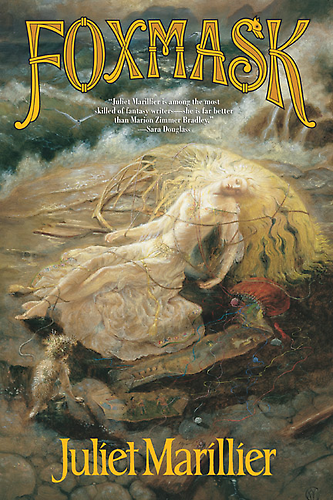 |
| ...whereas the cover for Foxmask is undoubtedly one of the most gorgeous covers arts I've ever come across! |
Heir to Sevenwaters is the story of Clodagh, the next generation of children born in the chieftaincy of Sevenwaters. When the story begins, her mother is about to give birth to the long-desired male heir. Even though the child is delivered in safety, disaster strikes soon enough when the newborn babe disappears and the family is left with a bunch of sticks vaguely resembling a baby. Only Clodagh sees how the changeling is an actual living, breathing being. The rest of the book is about her deciding to journey into the dangerous and unpredictable Otherworld to trade the changeling baby for her real brother. And also save the love of her life from eternal imprisonment, I might add.
Why she inspires me:
Throughout my own writing career (if that is not too much of an overstatement) I have been inspired and influenced by many writers, but none quite so prominently as Juliet Marillier. This influence first manifested when I was writing Moon Daughter (see my first post). Of course in retrospect I believe that I was copying Marillier’s style a little too much, but I was still trying to develop my own voice. Now I have found my own style and preferred themes, but I wonder if they had been quite the same if I had never picked up Daughter of the Forest that one day. Marillier writes about things that really work for me: folkloristic elements, especially the celtic folkore, that I have been interested in for as long as I can remember. I’m not so hot on the so-called “high fantasy” genre – with some exceptions, I usually feel that it’s a bit too much of a stretch to remain believable. Her approach is way more subtle, almost animistic in worldview. I also like it that she loosely adapts fairytales and legends. Daughter of the Forest, for example, is clearly based on the fairytale of the Seven Swans, which in turn originates from the old Irish tale The Children of Llyr.
Her main characters are another reason I favour this writer above many others. They’re always both very ordinary and domestic and at the same time quite extraordinary for their courage and willingness to plunge themselves into danger. They never seek the danger, but find that they are resourceful enough to face whatever comes their way. And of course, a theme that resonates within me very deeply: they know how to make their own choices.
In conclusion, I don’t think that Marillier’s books are always literary the deepest, artistically rendered or with the most variety, but I’ll always have a satisfactory read. And isn’t that what really matters the most, in the end?
Subscribe to:
Posts (Atom)