Ik heb van die momenten dat
ik het schrijven helemaal niet meer zie zitten. Niet dat ik geen boek uit wil
geven, maar de weg daar naartoe lijkt soms onmogelijk lang. Is het allemaal wel
de moeite waard? Zit ik niet al die jaren met een manuscript te worstelen om er
uiteindelijk achter te komen dat het nooit gepubliceerd zal worden? Wie denk ik
wel niet dat ik ben, amateurschrijvertje? Op dat soort momenten lijkt mijn boek
het meest zinloze, overbodige verhaal dat er ooit op de wereld is verschenen.
Wat moet je als schrijver met zulke inzinkingen?
Showing posts with label Island in the Mist. Show all posts
Showing posts with label Island in the Mist. Show all posts
Wednesday, 2 January 2013

Monday, 25 June 2012
Self-Publishing vs. Waiting for a real publisher
Whoa, I haven’t
been updating for a looong while. Perhaps it’s time to dust off this little
blog and put a new shine to it, eh? Lack of updates doesn’t mean lack of
writing, though! I have been working hard on Island in the Mist, and it’s now
mostly finished. It’s gone through a lot of editing, not in the least by an
editor who kindly offered to do it for free and to whom I owe a lot of gratitude!
Now it’s ready to be send to a professional who can hopefully also help me find
the right publisher for this thing :)
This stage
usually brings up an old question for me: do I want to try my luck with a real
publisher, or should I be satisfied with POD
– print on demand?
Tuesday, 1 November 2011
Day one
Words: 3062
Plot bunnies killed: 1
Unexpected extra plot bunnies gained: 0
Explosions, fire, betrayal! Dark secrets and dark prison cells! All in all, I’m rather pleased with my first 3000 words today :)
Wednesday, 26 October 2011
How to (not) prepare
It is nearly the start of Nanowrimo. I am excited and also mildly freaking out, because 1) I’ve got a busy month ahead and 2) I haven’t properly started plotting yet.
Tuesday, 4 October 2011
If my novel were a movie...
…Which, of course, would be one of the highest grossing movies of the year, with great young actors, gorgeous settings and a splendid soundtrack... Well, in the meantime, I’ve been whipping up some promotional posters. And no, none of those photos are actually mine. I used mostly movie screenshots and stock photography, though. But all the editing and photo manipulations are done by me.
Some pre-Nano preparations
Or: a brief update.
So, it’s October – the month before NaNoWriMo or National Novel Writing Month. This is usually where I start preparing for my upcoming month of novel-writing. This year, I’m hoping that Nano will give me the much-needed kick in the butt to finally finish the rough draft of my manuscript of Eiland in de Mist. In the meanwhile (well, on and off throughout the year), I’ve been working hard on rewriting the first half of the entire manuscript. It paid off, but it is hard working.
This blog has been very quiet, neglected and unupdated (is that even a word?) as of late. Expect way more activity once November actually starts though. That’s when the real work happens!
Right now, I’m working on getting the middle part of the novel right. I know what has to change, but actually changing it turns out to be a challenge. Because of this, I think it’s unlikely to be finished before the start of Nano, but that’s alright; I’ll just pick up the storyline and after November, I can write backwards. So, who knows? The first draft might actually be finished in two or three months.
Wednesday, 10 August 2011
No Mary Sueness
I just did the Mary Sue Test on Nimue and Arthur. They both scored a low 7 points. The test says:
Also, Briallen (from Vale of the White Horse, original fiction/ rpg character) scored 20:
Cool. The Mary Sues will not get to me!
0-16 pointsMost likely Not-Sue. Characters at this level could probably take a little spicing up without hurting them any.
Also, Briallen (from Vale of the White Horse, original fiction/ rpg character) scored 20:
17-21Probably not a Mary Sue, although a character can go either way at this point. Fanfiction writers should pay attention to ensure that their characters aren’t getting too Sue-ish. For an RPG or original fiction character, however, you’re probably perfectly fine.
Cool. The Mary Sues will not get to me!
Sunday, 7 August 2011
Fun research
Every person who ever tried to write a story that is not solely based on their own experiences probably knows that research is a must.
Personally, I love doing research. I will admit that mine is usually not as thorough as, say, Juliet Marillier’s…She gets to travel to Transylvania and Ireland and all sorts of nice places… and I don’t travel to a foreign country before I make it my new book’s setting. If I ever get a publisher who pays for such things, I will gladly travel the world!
And yes, I use a lot of Wikipedia, fully aware that information on the internet is not always a hundred percent accurate.
That being said, I do try to get my information as accurate as possible. The fun about research is that you get to study a wide array of different subjects. A few of my favorite subjects so far:
- The Inuit mythology and culture
- The art of glassblowing (and the more ancient techniques, and how to dye glass)
- Vocabulary and grammar rules of the ancient Goths. It’s sad that the website I used seems to be offline now.
- The tribes of Great Britain, especially during 45 AD and even more specifically about the Dobunni tribe, the Uffington White Horse and Uffington Castle.
- The effects of melting permafrost, acid rain and climate change
- Iron Age skills like baking bread, weaving and the building of roundhouses
- Iron Age environment in the Dutch county Drenthe
- EVERYTHING about the Yde Girl/ Het meisje van Yde. And I mean quite literally, everything that there is to find, from factual information to shady articles on European prehistoric sacrifices and an interesting audio drama. And for this I actually did go to the museum, since I actually live nearby for a change. Het Drents Museum has a lovely collection of prehistoric things, but the actual Yde Girl is the most wondrous of them all.
- Survival skills: how to cross a river, how to build many different kinds of shelter, how to build fire, how to hunt and catch fish, how to prepare or cook caught game/fish. This is really big theme in Island in the Mist (especially in the second book) My favorite site is http://www.wilderness-survival.net/ Bear Grylls was also very helpful.
So, to you, writers…Do you like research? What is or was your favorite subject?
Sunday, 3 July 2011
Sticking to your novel
So, this school year is wrapped up! My final presentation went very well, but I’m glad that it’s over. Summer vacation at last! I can’t quite comprehend the many days of free time I suddenly have. I have a few projects planned, like my herbal medicine course and doing some exercises to just work on myself. But mainly I want to focus on writing.
I’ve managed to do a lot of necessary rewriting the last two days. I’m glad I finally took the time to just do it, because I had the feeling I wasn’t getting any further. The first few chapters seem rather solid now (and there was much rejoicing). The beauty of rewriting several times is that you can keep adding little layers, until one time you read a scene or two and go, hey, this is getting pretty good! It may still be the first draft, but at least it’s Draft v.1.2!
That’s a good feeling – like all the hard work and all the struggling is paying off. It gives me the energy to continue, to stick to the novel until it’s finished. I think that’s the most important part of writing a book. Not to have a solid, polished story from the beginning, but sticking to what you do have; writing, deleting and rewriting, adding layers and changing small (or big!) scenes…Because one day you’ll take a look at it and nod to yourself approvingly. (Unless, of course, it’s becoming clear that there is No Future for the story, and the best thing is to bury it and proceed with something else. I’ve done this, too.)
Monday, 20 June 2011
My book is not my baby
Every so often I come across someone saying that his or her work of fiction is “their baby”. I get it, of course: that piece of literary greatness is something they cherish; they have been working on it until their fingers bled and their brains squeezed out unto the pages. Yes, it is something to take pride in! But goodness me, I do hope that it is not their baby. I don’t have children yet, but if I treated my baby the way I treat my novel, I’d be whipping her, chiseling her, cutting off body parts and replacing them with new ones – I’d be experimenting with size and shape of limbs until I finally found something satisfactory. That’d be a gruesome Frankenstein baby right there.
I like to think of my work as a rough woodcarving. I scrape and vile the wood until I see some sort of basic shape, then I turn it around and work some more on it; in due course the carving will start to resemble something lifelike. When it’s finished, yes, I take great pride in it. Some stories and old books are very dear to me, because they represent a phase of my life that I have fond memories of. But that’s really as far as it goes. And that is why I can handle criticism and also why I think the publisher actually does know best if they were to tell me that certain parts have to be rewritten. So many people go into Self-Publishing because they can’t stand having to change what they feel is already the perfect story. They don’t like being told what their baby should look like. I say pooh to that. A great book is never written by one person alone and it is never entirely right when you’ve finished with it. As a matter of fact, I wish I had a professional editor frowning over Het Eiland in de Mist right now, telling me exactly what does and doesn’t work, and help me get through the parts I get stuck in. That’s be the best help ever.
Wednesday, 15 June 2011
The right kind of voice
Since I’ve started writing Het Eiland in de Mist in November, I am nearing the end, but I haven’t finished yet. Instead, I came to a spluttering halt, observed the work in progress like a person walking around a house in scaffolds, and then decided to cut away most of the first scenes. On top of that, I felt that I needed to change from a third person narrative into a first person perspective; somewhat later I decided to also change everything to present tense. Big, big overhaul.
The reason for all this trouble was that I just couldn’t get the narrative right. It was, in turns, too stiff, too distant, too plain, and didn’t seem like the voice of a 16 year old. It turned out to be pretty hard to figure out how Nimue actually talks. I wanted it to be fresh and mature enough, but it just never felt quite right.
In retrospect I think that it was because I couldn’t decide how dark I actually wanted the story to be. As a result, I kept holding back because I thought that maybe certain things were not appropriate for young adults. Eventually I realized that I was making things harder for myself and more boring for the reader. After all, the YA literature out there can handle dark themes and edgy language, no problem! So why couldn’t I write it? Why was I stumbling over all my words, my sentences? Why was I doubting everything I wrote down? Was it too fancy, too matter-of-factly? Did I even know what I wanted it to be?
I figured maybe it was simply that I had forgotten what the voice of a young adult really sounds like. I have been sixteen of course, but oddly enough it’s hard to recall what I would talk like back then, or how I would think. Knowing very little teenagers, my best bet was simply to search for things I wrote back then. Good thing that I used to have a livejournal. My first entries are from 2003, making me around fifteen.
I scavenged the archive. Most of it was pretty silly; certainly not how I think Nimue would talk. But I did find some bits and pieces that possessed the right kind of grit, especially when I was touching on darker subjects in my own life. So that is what I want, and what I need, for Nimue: a voice that is real, raw and intimate.
After a few attempts to rework the initial first scenes, I finally gave up and decided that the plot wasn’t going to work that way, however much I kept altering it. Sometimes it’s just best to hit delete and start over from scratch. What I wrote instead is so much better for the story on so many levels, that Nimue’s voice feels much less like extracting blood from stones and much more like a natural thing.
How is this for you guys? When you’re writing, do you always get the voice right at once, or is it hard? If so, how do you work on it?
Monday, 13 June 2011
A closer look at Het Eiland in de Mist
I realized that it might be somewhat odd to have a whole blog dedicated (mostly) to the writing of this book, but not introducing it properly. So here I present a painfully long overview of my Big Masterpiece. Or something.
Saturday, 11 June 2011
Where stories come from
Sometimes people ask me where I get my ideas from. The truth is, I really have no clue at all; mostly, they just sort of happen.
Quick wisps of ideas come and go almost daily. I encounter something – a news article, a snippet of conversation, a song or maybe just cup of tea – and my head goes: “Oh, wouldn’t it be totally cool if……happened?!” Such ideas are usually immediately dismissed because they’re pretty silly.
There’s never really an absence of stories in my head. My first ever “novel” (In licht en schaduw) came to be because it was my own private bed time story first. And I still do that, making up stories before I fall asleep. Sometimes they’re just fragmentary, but usually they’re episodic, with a cast of characters and different locations and even a more-or-less coherent plot. Most of these stories are still not ready to be novelized, but I often pick a few small things to mix and match. Het Eiland in de Mist has come about this way, although most of those elements are reserved for the second volume.
This is more or less how Het Eiland in de Mist was thought into existence: before it was time to start thinking about my upcoming NaNo-plot, my bedtime story was based on the concept of a girl fleeing into the untamed wilderness with an escaped prisoner. They have all reason to believe that the authorities are chasing him, but along the way they find out that the real target is the girl. Who is she? What is she capable of that the government fears her even more than him?
After many thorough alterations, the girl became Nimue and the guy turned into Wolf. But I needed a reason as to why they were running, and from whom, what she was doing with a man like that and how he had managed to escape the Institution (The Asklepios Congregation, as they’re officially called). All of this slowly turned into the first book of the series, the one that I am currently writing. I also found that there was no room for Wolf in there at all, though Nimue will briefly spot him as an unknown figure in the shadows once she’s inside the Institution and trying to save Arthur. The absence of Wolf left me in need of a charismatic counterpart however, so I created Will, the character who will be key in the unfolding events.
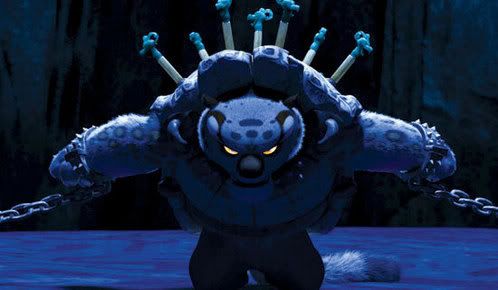 |
| How it all started! Creativity is a weird, weird process. |
Fun fact: the whole idea of a dangerous runaway criminal happened because I had watched Kung Fu Panda. The antagonist Tai Lung is kept chained up in a highly secured prison prior to his escape, and I had some sympathy for him (though I thought the rest of the movie was mediocre at best).
Does anyone recognize this at all? Or am I the only one whose mind is a jumble of half-finished ideas, characters and not-quite-useable storylines?
Wednesday, 8 June 2011
My theme in storytelling
I’ve been thinking about themes a while ago. All stories have one or two themes and they are especially present in the young adult literature. Working on Het Eiland in de Mist has made me wonder occasionally what the theme for that story is. The more I wondered, the more I felt lost. What’s the message I really want to convey? I kept asking myself. It was something I had to figure out, if I were going to really get a grip on that novel, but it was turning out to be harder than I’d thought.
By the way, I distinguish theme from story and plot. This was a bit confusing for me in the beginning, but Regina Brooks’ Writing Great Books For Young Adults helped me to understand the differences. The story is what’s going on in a linear direction, the plot is what the story comes down to and the theme is what has been silently going on all along: the core truth of the novel.
Getting back to Het Eiland in de Mist. I knew a few things that I wanted in there; environmental awareness, for example. Something to do with, uh, we have to be good for the earth or else we’ll ruin it for ourselves? That was really as close as I could get before I went blank. Since writing a novel is so much easier if you know what you want to be talking about, I decided to sit down and figure it out real and proper before writing another sentence.
And then I had a small epiphany.
You see, it wasn’t about environmental awareness and it wasn’t about finding out who you really are. Sure, both things are in there like the walls of a house, but they aren’t the house. I realized that my theme is in every story I write. What it boils down to is this: decision-making. Making your own choices. Becoming strong in your own mind – becoming free in your mind. For some reason, I always pick out (young) girls to explore this. I could argue that girls are simply easier to write, myself being a female. But that’s not entirely the whole truth, because I have had male main characters, and enjoyed writing them. So why, then? Has it something to do with feminism? Could it even be something spiritual? Maybe, maybe even both. And that is funny, because I have never actually considered myself to be a feminist. I wouldn’t even oppose much to a fairly more traditional male/female relationship, if I had the chance. But I’m hitting the essential part right away: I wouldn’t oppose, suggesting at once that I have a choice in the matter. And knowing your own mind and acting on it, well, that seems to me one of the scariest challenges in life. Because it is all too easy to behave in conformation of society. It’s easier to go with the flow, and live in a machinery structure that the generations before you have set up – school, study, then a job, hobbies and probably some family life; all rooted in a certain quality of living, because that’s what our western society provides. It’s nice, mostly.
And yet sometimes I feel that this whole pattern makes things fake – as though it’s hard to see and feel what real life, real living, is about, because I’m so embedded in a well-oiled machine that is the western civilization. It makes me wonder: who am I? Am I real, am I strong? Could I lead or follow? I don’t mean in a business-like structure. I sometimes have dreams where I am tested to the full limits of my human abilities. Could I lead and follow when lives depended on it? Have I lost the resourcefulness that made human kind what it is now? They are very primal things that I sometimes feel we have lost.
And here is where writing comes into it again. Because I need to explore such things and when I’m writing, I can. Call it escapism if you want, and maybe it is – but telling stories is my one way of discovering everything I have inside of me…My hidden fears, my inner strengths, my bad and redeeming qualities.
Obviously, I never really write about me. I do not want to create characters that have too much in common with myself, because where would the excitement be in that? But I have discovered a certain pattern in my characters…things that are about me, essentially – about who I am and who I’d like to be.
I think Jia (from Jia and the Cat Riders/ Jia en de Kattenrijders) is one of the earliest characters with such a specific growing arc. Jia en de Kattenrijders was primarily a coming-of-age story. (As James Marsters once put it when he was being interviewed about Buffy the Vampire Slayer: “All the vampires and demons are just the window dressing”. I feel this is true about most fantasy stories). Coming of age, the graduation from “childish” fears and apprehensions, is something that happens to us all in very many shapes. Jia discovered something about responsibility and social engagement. To be more precise: it was me who discovered this, along the way. When I started writing the book, I had no intentions of removing her from her parallel world. After all, in the world of Lynesse she was much braver, more successful; altogether a better version of herself. Given the chance, I probably would have swapped places with her at that time in my life. So why did I end the novel with her never going back? Because towards the ending of the story, I had started to realize that Jia had to face up to her own life, which is probably a parallel to my own coming-of-agey stuff. I mean, I was 17 or 18 at the time and I had to make some choices in life myself, while I had much rather hidden somewhere in a closet. So I made Jia do the responsible thing. I’m not even sure if I would have made that same decision, but I made her decide this because I knew that it was the Right Thing To Do. So in the end, my character Jia found that she was strong enough to make her own choices.
Another character of mine is not from any novel or short story, but from this roleplay that I used to enjoy with one of my friends. Jana was a second character that allowed me to explore what I might call it the “inner strength of girls”. Girl power! So perhaps this is about feminism after all? There certainly is a reason why I enjoy Juliet Marillier’s books so much, and why I’m such a big fan of the Buffy the Vampire series.
Jana was so sure of herself all along. She probably would have killed somebody if she had to, she was that kind of girl – yet on the other hand, she was so domestic. I always felt that she had this sense to always be correct, to be proper. She was incredibly pragmatic at times, and often even plain rigid. I realized that it was my own strictness there. I would almost say I’ve never had a character that I’ve liked so much as I like Jana – but then there are Briallen and Essylt, two characters from a current roleplaying game (rpg). I realize that they are pretty minor in terms of importance; especially since they’re not part of the novel that this blog should be about. I mention them because the theme of making your own choices is important with them. They are so different, but I can never make up my mind about which one I like best. Perhaps I might even go as far as suggest that both represent a different part of myself. Briallen is mature, earthy and very aware of herself. She embraces her responsibilities and she is, most of all, a little bit regal and proud. Not vain, just proud. Essylt, on the other hand, is far more insecure, much younger in behavior and probably more spoiled (I accidentally wrote spoilt there – that’d be just the exact opposite of the pristine girl that she is, haha). She wants the male protagonist for the way he makes her feel, but never musters enough bravery to take the leap of getting into an actual relationship with him. She’s been protected her whole life, she’s been lived her entire life, and only now has to face up to it on her own. Who will she become? Because with all that fairy power running through her body, making an actual decision will be vital. Deciding her own fate will matter. And she is scared to death.
But, as with all my characters, she is getting there. Because making your own decisions matters. It matters so much that I cannot stop writing about it. When you really make a choice based on your own mind, in absence of fear, is that not the moment where you become free? Isn’t that what freedom comes down to, in the end?
 |
Not all my characters are in doubt of what they want. This girl sees, wants, and takes .(from my fairytale, The Wooden Heart) |
Knowing what you want is a pretty daunting task. It means you’ll have to figure out who you actually are, on the inside of your existence. And that’s what I want Nimue to explore in Het Eiland in the Mist and the following two volumes; who she is, what her values are, how strong she can be in the face of danger and which decisions she is going to make when it comes to morally grey areas. This is not about my own psychology, though I can never shut myself out completely. Nimue isn’t even like me. But if I manage to get this theme running beneath the story that I have set out for her, I’m in for a very exciting adventure.
Next post might be about the stories in my head that will never come out. I like writing about writing and storytelling. But it does feel a bit like stalling from the actual work of getting that manuscript out of my brain and into the empty pages of word.
Now I'm going to end this very long post with an appropriate quote from my current favourite show Buffy, brought to you by Spike:
"The day you suss out what you do want, there’ll probably be a parade. Seventy-six bloody trombones."
Subscribe to:
Posts (Atom)